How Much Skincare Contains Fragrance? We Checked 3,471 Ingredient Lists
We ran every ingredient list in Vessa's product catalogue through the same rules as our ingredient checker. Here is how often fragrance shows up, by category, and what the label can hide.
7 min read
About 3 in 10 skincare products in our catalogue list fragrance by name, and about 4 in 10 list either fragrance or one of the common scent allergens. We checked 3,471 ingredient lists on 7 November 2026 with the same rules our ingredient checker uses. Sunscreens and eye creams had the least; lip care, exfoliants and cleansers had the most.
The short version
- 28.7% of the 3,471 lists name fragrance, parfum or aroma.
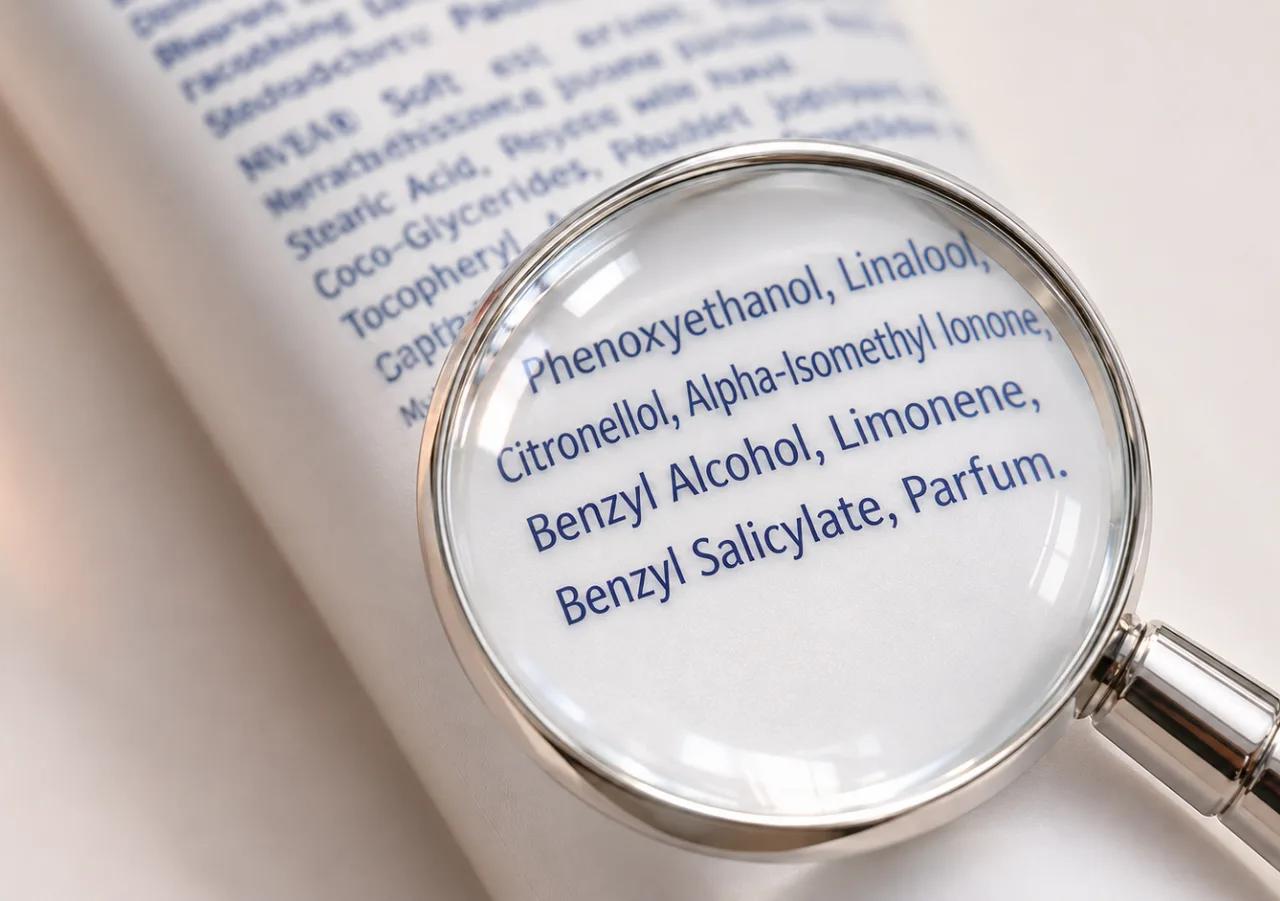
- 23.9% name at least one of six scent allergens: limonene, linalool, geraniol, citronellol, citral or eugenol.
- 10.7% name one of those six without the word fragrance anywhere on the list.
- 39.4% have fragrance, one of the six, or both.
- 56.4% have something our checker flags as scent-related once you add the scented plant oils and extracts the app treats like fragrance.
So if you only scan a label for the word fragrance, you'll miss roughly one product in ten that still carries a named scent allergen.
Fragrance by product type
Percentages of products in each category whose ingredient list includes each item. A product can count in more than one column.
| Category | Products | Lists fragrance, parfum or aroma | Lists one of the six allergens | Fragrance or one of the six | Any scent flag (incl. plant oils and extracts) |
|---|---|---|---|---|---|
| Moisturiser | 726 | 34% | 29% | 45% | 61% |
| Serum | 692 | 25% | 23% | 35% | 51% |
| Cleanser | 405 | 33% | 25% | 47% | 66% |
| Sunscreen | 315 | 22% | 12% | 28% | 36% |
| Eye care | 308 | 20% | 14% | 26% | 50% |
| Treatment | 241 | 25% | 20% | 34% | 56% |
| Mask | 240 | 31% | 23% | 40% | 56% |
| Lip care | 153 | 50% | 35% | 61% | 73% |
| Toner | 125 | 18% | 19% | 30% | 46% |
| Exfoliant | 125 | 32% | 35% | 51% | 74% |
| Mist and essence | 101 | 34% | 34% | 47% | 59% |
| Face oil | 40 | 18% | 50% | 53% | 85% |
| All | 3,471 | 28.7% | 23.9% | 39.4% | 56.4% |
Two things stand out. Sunscreen had the lowest rates in every column, which is good news for the one product you're meant to wear every day. And face oils rarely say fragrance but often carry the allergens, because essential oils bring them in naturally. With only 40 face oils, treat that row as a hint, not a finding.
Lip care is a special case: in lip products aroma usually means flavour. Nineteen of the lip products were flagged only because of aroma or flavor.
The allergens that showed up most
Counted across all 3,471 lists:
| Ingredient | Lists it appears on |
|---|---|
| Limonene | 637 |
| Linalool | 618 |
| Geraniol | 354 |
| Citronellol | 326 |
| Benzyl alcohol | 261 |
| Citral | 227 |
| Benzyl benzoate | 92 |
| Benzyl salicylate | 80 |
| Hexyl cinnamal | 75 |
| Eugenol | 66 |
Benzyl alcohol is on the EU's list of labelled fragrance allergens, but it is also a common preservative, so it isn't in our "six allergens" column. You can read what each one is on our pages for fragrance and essential oils.
Why "fragrance-free" is harder to check than it sounds
In the US, the label can hide the details. The FDA says fragrance and flavour ingredients can be listed simply as "Fragrance" or "Flavor", and that even some products labelled "unscented" may contain fragrance ingredients (FDA, "Fragrances in Cosmetics", content current as of 28 February 2022). The 2022 Modernization of Cosmetics Regulation Act lists fragrance allergen labelling among the rules the FDA has to write (FDA, MoCRA page, current as of 29 October 2026).
In the EU, more allergens get named. Fragrance is listed as parfum or aroma (Regulation (EC) No 1223/2009, Article 19). Named allergens must appear on the list above 0.001% in leave-on products and 0.01% in rinse-off products. A 2023 regulation extends that rule from the 24 allergens already listed to dozens more identified by the EU's scientific committee, with transition dates running to 2028 (Commission Regulation (EU) 2023/1545). So the same product can show more names on an EU label than on a US one.
Unscented is not fragrance-free. The American Academy of Dermatology explains that unscented can mean a fragrance has been covered up, and suggests products labelled fragrance-free for eczema-prone skin (AAD, atopic dermatitis skin care, last updated 10 October 2023).
Does fragrance matter for your skin?
For many people, no. For some, yes. The AAD names fragrance as one of the more common causes of allergic contact dermatitis (AAD, contact dermatitis overview). The EU's scientific committee estimated that 1–3% of the general population in Europe is allergic to fragrance ingredients, based on limited testing, and that around 16% of eczema patients are sensitised (SCCS opinion on fragrance allergens, adopted June 2012). The 2023 EU regulation puts the share of the population allergic to fragrance allergens at 1–9%.
If you have eczema, rosacea, reactive skin or a known fragrance allergy, the ingredient list is worth reading. If a product with fragrance has always been fine for you, these numbers aren't a reason to throw it out.
How we counted
- Source. Every product in Vessa's catalogue that is shown in the app's Products tab, as of 7 November 2026: 5,199 products, of which 3,515 have a full ingredient list.
- What we read. Only each product's category and its ingredient list (INCI). No names, brands, prices or ratings.
- What we left out. Beauty tools, and lists with fewer than five ingredients, which are usually incomplete. That leaves 3,471 products.
- The rules. Each list went through the same code as our ingredient checker, so the post and the checker agree:
- Fragrance: an entry containing parfum, fragrance or aroma.
- Six allergens: limonene, linalool, geraniol, citronellol, citral and eugenol, the ones Vessa's reactive-skin rule looks for.
- Any scent flag: fragrance, any labelled fragrance allergen, or a scented plant oil or extract such as lavender, citrus peel, mint, eucalyptus, rosemary or tea tree.
- The limits.
- The catalogue leans toward products sold by large US beauty retailers such as Sephora and Dermstore. It isn't a random sample of all skincare, and drugstore and non-US brands are under-represented.
- Ingredient lists come from retail listings and can lag behind reformulations.
- A product with no fragrance on its list may still contain scent molecules below labelling thresholds, or under a US "fragrance" entry we can't see inside.
- Some plant extracts we flag are used for other reasons, such as rosemary leaf extract as an antioxidant. That's why the broadest column is the highest.
How to check a product yourself
- Find the full ingredient list, not the front-of-pack claims.
- Paste it into the ingredient checker. It marks fragrance, the named allergens, scented plant oils, drying alcohol and the actives, and says why.
- Patch-test anything new if your skin reacts easily. The AAD suggests a quarter-sized spot, twice a day for seven to ten days (AAD, "How to test skin care products", last updated 10 August 2021).
- Check the label before you buy: paste the ingredient list into the ingredient checker.
In the app, you can add fragrance and essential oils to your avoid list, and every product is checked against its full ingredient list, including the bottles you photograph with Vessa's product scanner. The Products tab also has a fragrance-free filter.
Vessa is a skincare app, not medical advice. If you think you're reacting to a product, stop using it, and see a dermatologist for patch testing if it keeps happening.
Frequently asked questions
In our check of 3,471 ingredient lists on 7 November 2026, 28.7% named fragrance, parfum or aroma, and 39.4% named fragrance or one of six common scent allergens. The catalogue leans toward large US beauty retailers, so other shelves may differ.
In our data, sunscreens (22% list fragrance), eye care (20%) and toners (18%) were the lowest. Lip care was the highest at 50%, partly because aroma there usually means flavour.
No. Unscented can mean a fragrance was added to cover other smells. Look for fragrance-free, then check the ingredient list for parfum, fragrance and the named allergens.
The label might not say fragrance and still list them. 10.7% of the lists we checked named one of six scent allergens without naming fragrance, often from essential oils or plant extracts.
Not for everyone. Fragrance is one of the more common causes of allergic contact dermatitis, so it matters most if you have eczema, rosacea, reactive skin or a known allergy.
Sources
- FDA, "Fragrances in Cosmetics", content current as of 28 February 2022. fda.gov
- FDA, "Modernization of Cosmetics Regulation Act of 2022 (MoCRA)", content current as of 29 October 2026. fda.gov
- Regulation (EC) No 1223/2009 on cosmetic products, Article 19, 30 November 2009. eur-lex.europa.eu
- Commission Regulation (EU) 2023/1545, 26 July 2023. eur-lex.europa.eu
- Scientific Committee on Consumer Safety, "Opinion on fragrance allergens in cosmetic products" (SCCS/1459/11), adopted 26–27 June 2012. health.ec.europa.eu
- American Academy of Dermatology, "Eczema types: Contact dermatitis overview", last updated 14 December 2020. aad.org
- American Academy of Dermatology, "Eczema types: Atopic dermatitis skin care", last updated 10 October 2023. aad.org
- American Academy of Dermatology, "How to test skin care products", last updated 10 August 2021. aad.org