How to Build a Skincare Routine From Products You Already Own
Sort your shelf, read the ingredient lists, drop the duplicates and put what's left in the right order, before you buy anything new.
6 min read
You can usually build a full routine from what's already on your shelf. Sort the products by job, read each ingredient list for its actives, keep one product per job, and keep strong actives apart. Then layer them thinnest to thickest, with sunscreen last every morning. Buy only for a step that's still empty.
Step 1: Take everything out and sort it by job
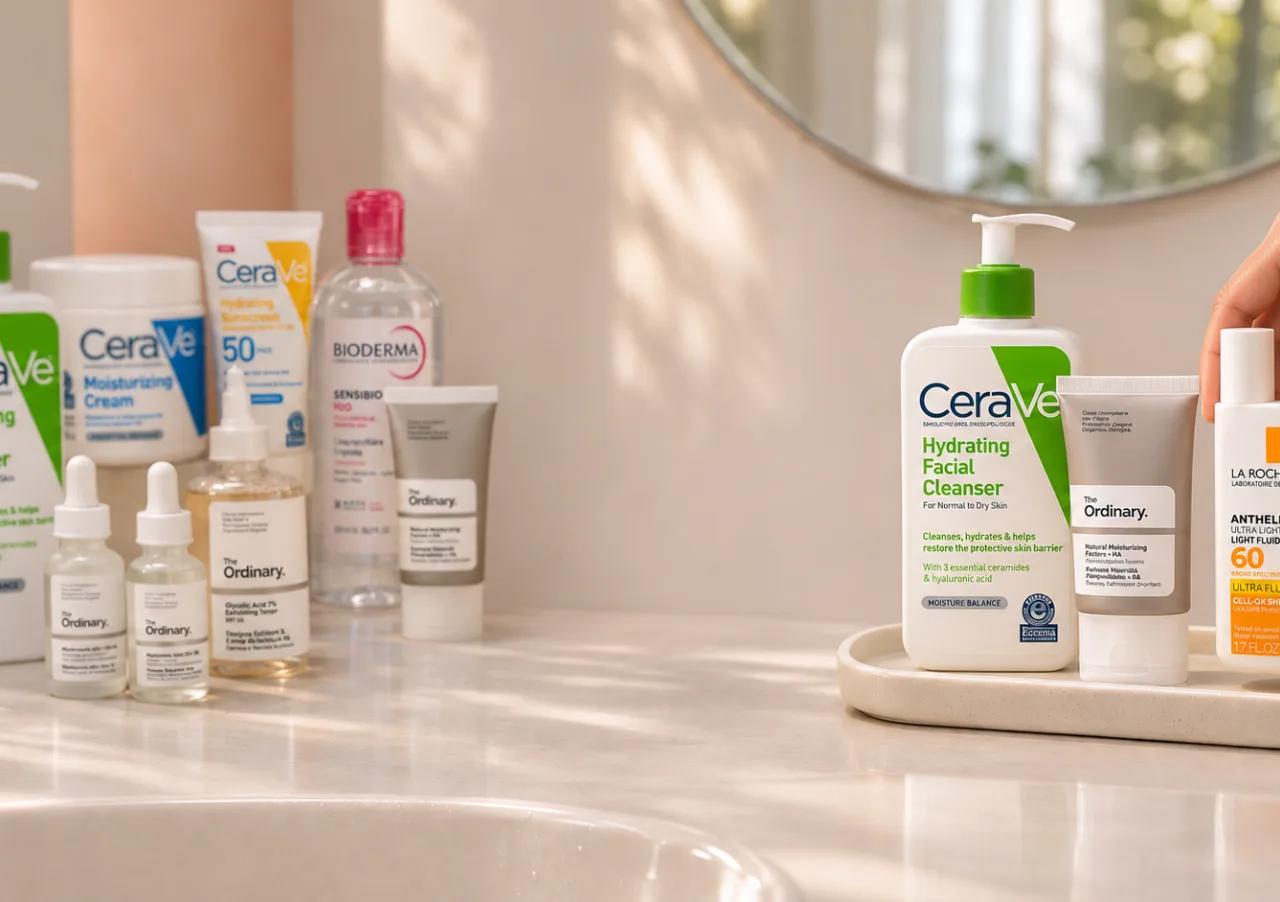
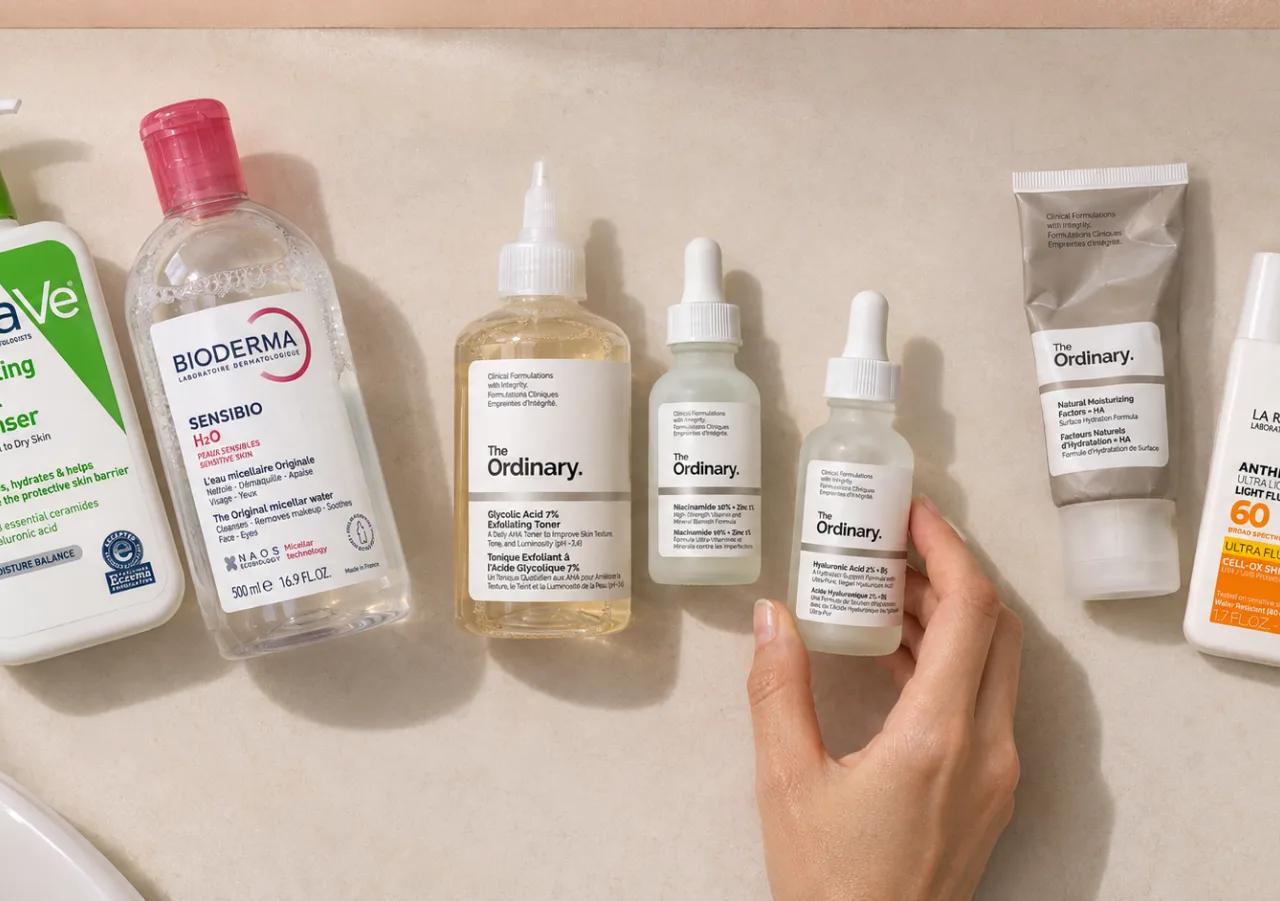
Put every product on a table. Then group them by what they do, not by brand or by how much you like the bottle.
| Group | What goes in it |
|---|---|
| Cleansers | Gels, foams, creams, oil or balm cleansers |
| Exfoliants | Leave-on AHA, BHA or PHA toners, serums and pads |
| Retinoids | Retinol, retinal, retinoid serums and creams |
| Treatment serums | Vitamin C, niacinamide, azelaic acid, peptides |
| Hydrators | Hydrating toners, essences, hyaluronic acid serums |
| Eye care | Eye creams and gels |
| Moisturisers | Day and night creams, gels, lotions, face oils |
| Sunscreen | Anything with an SPF that you'd wear on your face |
Throw out anything that has changed colour, smell or texture, or that you can't remember opening. A product past its best is not a saving.
Step 2: Read the ingredient lists, not the front of the bottle
The front tells you what the brand wants you to notice. The ingredient list tells you what's in it. In the US, ingredients are listed "in descending order of predominance" (21 CFR 701.3). EU rules say the same, by weight (Regulation 1223/2009, Article 19). Under both, ingredients at around 1% or less can be listed in any order after the rest.
So a few things are worth checking:
- Where the active sits. An acid near the top is there to exfoliate. Low in the list, it's often there to set the pH.
- Hidden actives. A "glow toner" may be a glycolic acid exfoliant. A "renewing cream" may contain retinol.
- Fragrance and essential oils, if your skin reacts to them.
Not sure what a list contains? Paste it into the ingredient checker. It shows the actives it finds and what each one means for when and how often you use it.
Step 3: Find the duplicates
Most crowded shelves have two or three products doing the same job. Look inside each group from Step 1:
- Two vitamin C serums? Keep the one you opened first and finish it.
- A retinol serum and a retinol night cream? One retinoid is enough. Using both just doubles the irritation risk.
- Three moisturisers? Keep a lighter one for the morning and a richer one for the night, if you like that. Put the third away.
Two products with the same key actives are duplicates even if the brands differ. Paste each label into our ingredient checker to see its key actives side by side.
Step 4: Check what doesn't go together
Some actives are fine together. Others need different times of day or different nights. The common rules:
- Retinoid and exfoliating acid: different nights. See retinol with glycolic acid and retinol with salicylic acid.
- Vitamin C and retinoid: vitamin C in the morning, the retinoid at night (retinol with vitamin C).
- Benzoyl peroxide and retinoid: not on the same evening (retinol with benzoyl peroxide).
- Two exfoliants: not on the same night (exfoliant with exfoliant).
- Niacinamide sits comfortably with most things (retinol with niacinamide).
If you're pregnant or breastfeeding, retinoids come off the shelf for now. Read pregnancy-safe skincare and ask your doctor about anything you're unsure of.
Step 5: Put it in order
The rule of thumb from Cleveland Clinic is to go "from lightest to heaviest (or thinnest to thickest)". In practice:
Morning: cleanser → hydrating toner or serum → vitamin C or another treatment serum → eye cream → moisturiser → sunscreen.
Evening: cleanser → retinoid or exfoliant (on its own nights) → hydrating serum → treatment serum → eye cream → moisturiser.
Pick your actual products in our routine order tool and it lays out the order and which nights the retinoid and the acid go on.
Step 6: Decide what to finish first, and what to stop buying
Now you have a routine and a pile of leftovers. Sort the leftovers too:
- Finish first: a duplicate that's already open. Use it up, then switch.
- Keep for later: an unopened backup of something in your routine.
- Don't buy again: anything that stung, broke you out or did nothing you could see after a fair trial. The AAD says most products take at least six weeks to work.
- Give away: sealed products that don't suit your skin.
Step 7: Fill the gaps slowly
Only now look at what's missing. For most people the one step that can't be skipped is a broad-spectrum sunscreen, SPF 30 or higher, every morning. Add one new product at a time. The AAD's patch test is simple: apply it to a small test spot twice a day for seven to 10 days and watch for redness, itching or swelling.
Where an app helps
This takes an evening with a pile of bottles. Vessa does the sorting from photos. You photograph a bottle and it identifies it and reads its ingredients. Each product on your shelf gets a verdict: Keep, Finish First, Duplicate, Do Not Repurchase, Not Recommended, Optional or Needs Review, with a short reason. Your routine prefers what you own and only replaces something with a stated reason. When your shelf changes, it offers to rebuild the routine.
The limits of doing it yourself
An ingredient list shows what's in a product, not how much. Two serums with the same actives can feel very different on your skin. The order in a list also stops being exact below 1%. And no shelf sort can tell you whether a rash or a breakout that won't settle needs treatment. That's a question for a dermatologist.
Vessa is a skincare app, not medical advice. If a product burns, swells or keeps irritating your skin, stop using it and talk to a doctor or pharmacist.
Frequently asked questions
Three covers the basics: a cleanser, a moisturiser and a sunscreen in the morning. Everything else is there for a specific goal.
You can, but it rarely helps. Two exfoliants or two retinoids raise the chance of irritation more than they add results. Finish one, then use the other.
Use them at different times. Vitamin C in the morning, a retinoid at night, and an exfoliating acid on nights without the retinoid.
Not right away. Keep sealed ones to give away, finish open duplicates, and only bin products that have gone off or that irritated your skin.
Sources
- Cleveland Clinic, "How To Order Your Skin Care Routine", 5 September 2025: health.clevelandclinic.org
- American Academy of Dermatology, "How to test skin care products", last updated 10 August 2021: aad.org
- American Academy of Dermatology, "How to maximize results from anti-aging skin care products": aad.org
- US Code of Federal Regulations, 21 CFR 701.3, Designation of ingredients (Cornell LII copy): law.cornell.edu
- Regulation (EC) No 1223/2009 on cosmetic products, Article 19: eur-lex.europa.eu